 Any questions about history, geography, science, etc., as well as Vikidia itself and how it works? Ask The Scholar!
 Luxembourg
 This article is about the country. If you are looking for other subjects titled "Luxembourg", read Luxembourg (disambiguation).
| Grand Duchy of Luxembourg | |
|---|---|
 |
 |
| Flag | Coat of arms |
| Motto | Mir wëlle bleiwe wat mir sinn |
| National anthem | Ons Heemecht
|
| Location | |
 |
|
| Geography | |
| Capital | Luxembourg |
| Largest city | Luxembourg |
| Area | 2,586.4 km2 |
| Bordering countries |  Germany Germany Belgium Belgium France France |
| Time zone | UTC+1, UTC+2 (daylight saving time) |
| Demographics | |
| Population | 645,397 (as of 2,022) inhabitants |
| Density | 228.4 inhabitants/km2 |
| Demonym | Luxembourger, Luxembourgeoise |
| Official language(s) | Luxembourgish, French, and German |
| Politics and Government | |
| Formation | Independence from the Netherlands |
| Date | November 23, 1890 |
| Grand Duke | Henri |
| Prime Minister | Luc Frieden |
| Currency | Euro |
| Telephone dialing code | +352 |
| Edit | see template • edit |
Luxembourg (in Luxembourgish: Lëtzebuerg; in German: Luxemburg), or the Grand Duchy of Luxembourg (official/long form), is a small state in Western Europe, a member of the Benelux, the European Union, and NATO. Its capital is also called Luxembourg. In 2022, it had a population of over 645,000.[1] It is one of the founding members of the European Union and is the second-smallest country in the EU after Malta. It is also the only grand duchy in the world.
In 2014, Luxembourg was considered one of the most prosperous countries in the world, with a GDP of 115,000 dollars per capita.[2]
The national language is Luxembourgish. The official languages are German, French, and Luxembourgish, but other languages are also used regularly, such as English, Portuguese, and Italian due to the diverse origins of the population.[3]
Luxembourg's national holiday is June 23, the Grand Duke's birthday.
Geography[change | change source]

Location[change | change source]
Luxembourg shares land borders with:
- Belgium to the west and north (148 km);
- Germany to the east and northeast (135 km);
- France to the south (73 km).
Located in the heart of Western Europe, it has no access to the sea.
However, its geographical location gives it a significant linguistic advantage. In school, children learn several languages other than Luxembourgish. Starting in first grade, children learn to read and write in German, then later in French, with English generally serving as the third foreign language if Luxembourgish is their native language. Only nursery school and kindergarten are conducted in Luxembourgish.
Area[change | change source]
With an area of 2,586 km2, Luxembourg is smaller than Belgium and the Netherlands combined.
It is one of the smallest countries in Europe and one of the smallest in the European Union.
It extends a maximum of 82 km in length (from north to south) and 57 km in width (from east to west).
Natural Regions[change | change source]

The two largest natural regions are:
- the Oesling or Ardennes in the north: 828 km2; average elevation of 450 m;
- the Gutland or Bon Pays in the center: 1,758 km2; average elevation of 215 m.
Other notable areas include:
- the mining basin in the south;
- the Moselle valley in the east.
Rivers[change | change source]
The four most important rivers are the Moselle, the Sûre, the Our, and the Alzette.
History[change | change source]
 To learn more, read the article: History of Luxembourg.
Timeline[change | change source]
- 963: Foundation of Luxembourg.
- 1795–1814: Luxembourg is known as the Department of Forests
- 1815: Luxembourg becomes a grand duchy.
- 1839: It becomes an independent state from the Netherlands; it gains autonomy, but more than half of the country is assigned to Belgium.
- 1867: Achieves full independence.
- 1948: Luxembourg ends its neutrality after being invaded by Germany during the First and Second World Wars; it joins the Benelux Customs Union.
- 1949: It joins NATO.
- 1957: It becomes one of the six founding members of the European Economic Community, which would later become the European Union.
- 1999: Adoption of the euro.
- 2000: Grand Duke Henri of Luxembourg succeeded his father, Jean, who had abdicated in his favor.
The history of Luxembourg reflects the changes the country has undergone over the centuries. Located in the heart of Europe, between France, Belgium, and Germany, the Grand Duchy of Luxembourg has been a major player in European development: its eventful past as a Grand Duchy serves as a microcosm of European history. The story begins with the first human settlements in the territory that is now Luxembourg. In addition to the groups of people already present during the Paleolithic and Neolithic periods, successive waves of Celts arrived during the Bronze and Iron Ages, followed by Germanic peoples (Ripuarian Franks and, likely, Alemanni) around the 3rd century.
The Flag[change | change source]
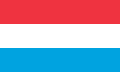
The Luxembourgish flag is a horizontal tricolor, with red at the top, white in the middle, and light blue at the bottom. It resembles the flag of the Netherlands, differing only in the shade of blue (which is lighter for Luxembourg). It has existed since the  19th century, but was not officially adopted until 1972.
Demographics[change | change source]

Luxembourg has more than 645,000 inhabitants in 2022 and has experienced high population growth (68%) over the past 50 years, due to significant immigration. As a result, nearly 50% of its population is foreign, meaning that half of the inhabitants do not hold Luxembourgish citizenship. According to the government’s official website, the country’s population includes 14.5% Portuguese nationals and 7.6% French nationals.[1]
In addition to its resident population, there are also around 197,000 cross-border workers who live in France, Belgium, or Germany and work in Luxembourg.
Economy[change | change source]

After gaining its independence, Luxembourg was initially one of the poorest and least developed countries in Europe. The discovery of iron ore in the south of the country enabled the development of the steel industry, until Luxembourg became the world’s largest steel producer by the mid-20th century[4], which greatly contributed to improving its prosperity. Following the steel crisis of the 1970s, the country began to reorient and diversify its industry, initially toward the financial sector, and more recently also toward sectors such as education, IT, and space.
References[change | change source]
- ^ a b https://luxembourg.public.lu/fr/societe-et-culture/population/demographie.html
- ^ http://m.journaldunet.com/journaldunet/economie/magazine/classement-pib.shtml
- ^ https://luxembourg.public.lu/fr/societe-et-culture/langues/langues-au-luxembourg.html
- ^ https://luxembourg. public.lu/fr/investir/competitivite/portrait-luxembourg-economie.html
|
|
|


| European Union | |
|---|---|
| European Union candidates | |
| EFTA | |
| Other countries | |
| States not recognized by the international community |


