
Morocco
| Kingdom of Morocco | |
|---|---|
 |
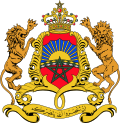 |
| Flag | Coat of arms |
| Motto | Dieu, la Patrie, le Roi Allah, Al Watan, Al Malik Akuc, Amur, Agllid |
| National anthem | Sharifian Anthem |
| Location | |
 |
|
| Geography | |
| Capital | Rabat |
| Largest city | Casablanca |
| Area | 710,500 km2 |
| Rank | Ranked 41th |
| Water | 0.056 % |
| Time zone | UTC+0, UTC+1 (daylight saving time) |
| Demographics | |
| Population | 36,471,769 inhabitants |
| Rank | Ranked 40 |
| Density | 81 inhabitants/km2 |
| Demonym | Moroccan |
| Politics and Government | |
| Formation | Baya'a of Idris I |
| International organizations | WTO, Organisation internationale de la Francophonie, Organization of the Arab League |
| Currency | Moroccan Dirham |
| Telephone dialing code | +212 |
| Edit | see template • edit |
Morocco (in Arabic: al-Maġhrib ٱلْمَغْرِب, in Tamazight: Lmeġrib ⵍⵎⵖⵔⵉⴱ) is a country in Africa, more specifically in North Africa. Morocco is a constitutional monarchy. Its political capital is Rabat. Morcco has a population of about 37 million people.
The Western name Morocco comes from the name of the country's former capital, Marrakesh (Amurakuc, short for Amur n Akuc, meaning "Land of God" in the Berber language).
Morocco is the only African country with access to both the Mediterranean Sea and the Atlantic Ocean.
The currency is the Moroccan dirham.

History[change | change source]
 To learn more, read the article: History of Morocco.
The first inhabitants of Morocco were the Amazigh (Berbers), whose language speakers are now divided into three major linguistic areas: Tarifit, Central Tamazight, and Tachelit.
In the 8th century, the first Moroccan dynasty (the Idrisids) came into being in 788 with the arrival of Idris Ibn Abdallah. Several dynasties (Almoravids, Almohads, Merinids, Saadians, etc.) succeeded one another in the country, leading to the Alawites, who still reign today.
On November 18, 1956, France signed Morocco's independence. This marked the end of the protectorate that began in 1912.
Geographic characteristics[change | change source]

The country's surface area is 710,500 km2, or 446,550 km2 if Western Sahara is excluded. Western Sahara is claimed by a political organization, the Sahrawi Arab Democratic Republic, but is currently part of the Kingdom of Morocco. Since 2007, the United Nations has been working to have this territory remain part of Morocco with federal management of the Sahrawi people.
Morocco is crossed by the Atlas mountain range, dominated by Mount Toubkal.
Morocco is separated from Spain by the Strait of Gibraltar.
Climate[change | change source]

The climate in Morocco is very diverse, with the country being influenced by three different climates:
- Mediterranean climate on the Atlantic coast from Tangier to Agadir and along the entire Mediterranean coast;
- Mountain climate in the Atlas mountain range, the Middle Atlas and the Anti-Atlas;
- desert climate in the Saharan and southern regions.
Current leaders[change | change source]
- Current king (since 1999): Mohammed VI, of the Alaouite dynasty
- Minister of Defense: Abdellatif Youdyi[1]
Culture[change | change source]
Cuisine[change | change source]
To learn more, read the article: Moroccan cuisine.Moroccan cuisine is renowned for its flavor. Mint tea (Arabic pronunciation: atéï) is the national drink, also known as "royal tea". Couscous and tajine are two Moroccan culinary specialties. The majority of the population does not eat pork because they are Muslim. There are also many types of pastries: gazelle horns, briouat, baghrer, msemen, harcha, faaquas, aghroum...
Economy[change | change source]
Morocco, an emerging country since the 21st century, has a liberal market economy governed by the law of supply and demand. It benefits from a flourishing macroeconomic situation, with a gross GDP of 90,804,562,156 (or 103.5 billion dollars: unclear information) in 2010, representing a growth rate of around 6.5 % over the last five years (2010 statistics). This GDP is divided into three distinct areas: agriculture with 19.2 %, industry with 31.4 %, and services with 49.4 %. Morocco also benefits from a thriving tourism industry. Thanks to its geographical location, with coastlines on both the Mediterranean Sea and the Atlantic Ocean, the Kingdom of Morocco exports foodstuffs such as olives and olive oil, and resources such as minerals (copper, coal, and phosphate) to all continents. Its economic capital is Casablanca.
Sectors[change | change source]

The three sectors of economic activity in Morocco are growing rapidly, although despite the importance of agriculture and industry in the country, the third sector (services and trade) is the sector that employs the most people.
Agriculture[change | change source]

Morocco has many agricultural products. Among them are:
- citrus fruits, with 1.8 million tons harvested each year;
- vegetables and fruit in general, which are one of the country's exports;
- wheat, which according to statistics could be sufficient to meet 90 % of local consumption for the year 2009-2010.
Fishing[change | change source]
Fishing is one of Morocco's key industries thanks to the country's diverse climate and coastline, which borders both the Mediterranean Sea and the Atlantic Ocean.
Among the fish caught are tuna, mackerel, sole, whiting, and sardines.
Morocco has signed a fishing agreement with the European Union concerning European vessels off the Moroccan coast.
Minerals[change | change source]
The mineral for which Morocco is known is phosphate, with the highest export in the world and the second highest production (with 20.68 % of the world's share). Morocco has 70% of the world's reserves of phosphate, a mineral essential for the manufacture of fertilizers for agriculture.
There are other minerals in Morocco, including zinc, iron, cobalt, gold, copper, silver, and so forth.
Industry[change | change source]
Morocco's industry is experiencing rapid growth despite being affected by the financial crisis and competition from China.
Unemployment[change | change source]
Unemployment in Morocco is estimated at 9.6 %. However, this figure remains uncertain as several economic activities are not taken into account by official studies.
Stock market[change | change source]
Despite the country's economic crisis, the Casablanca stock exchange remains in second place in the African stock market rankings.
Medical studies[change | change source]
Morocco has several state and private medical universities that accept international students.
Tourism[change | change source]

Tourism plays a major role in Morocco's economy. The country has a significant infrastructure for welcoming tourists, with several coastal cities, a varied climate and natural landscapes, as well as numerous historical monuments. The cities that welcome several thousand tourists are (in descending order):
- Marrakesh: 39,550 beds;
- Agadir: 27,904 beds;
- Casablanca: 12,656 beds;
- Tangier: 7,371 beds;
- Fez: 6,802 beds;
- Ouarzazate: 6,716 beds;
- Rabat: 4,812 beds;
- Tetouan: 3,821 beds;
- Meknes: 2,936 beds;
- Essaouira: 2,618 beds;
- Others: 28,035 beds.
Total: 143,221 beds.
In 2019, Morocco welcomed 13 million tourists. In 2007, the number of tourists was around 7 million, and travel revenues amounted to nearly 8.16 billion dollars.
Military[change | change source]
The Moroccan army is gradually equipping itself with military drones purchased from various countries (the United States, Israel, Turkey, China), having been the first country in North Africa to use them in 1986. These devices have the advantage of being less expensive than fighter jets, while being effective enough for surveillance, search and destruction of targets on land, at sea and in the air.[2]
2023 Morocco earthquake[change | change source]
The 2023 Morocco earthquake was a devastating earthquake that occurred on September 8, 2023 in the High Atlas region, a mountain range located in central Morocco. The earthquake caused extensive damage and claimed many lives.
The earthquake had a magnitude of 6.8 on the Richter scale, according to the National Institute of Geophysics of Morocco. Its epicenter was in the Al Haouz region, about 70 kilometers southwest of Marrakesh, a major tourist city in the country. The depth of the earthquake was estimated at approximately 18 kilometers, making it a shallow earthquake, which amplified its destructive effects.
The earthquake caused the deaths of more than 2,900 people and left several thousand injured. Many buildings were destroyed, particularly in remote mountain villages. These villages often consist of houses made of earth and stone, materials that are vulnerable to seismic shocks.
The cities of Marrakech, Ouarzazate, and Taroudant also suffered significant damage. In Marrakech, parts of the historic ramparts, a UNESCO World Heritage Site, were damaged.
Reactions and solidarity[change | change source]
The earthquake sparked a huge wave of national and international solidarity. King Mohammed VI ordered relief efforts to be organized to help the victims. Several countries offered their support by sending search and rescue teams.
In Morocco, the population mobilized to help the victims, notably by collecting donations, distributing food, and providing temporary shelters.
Prevention and reconstruction[change | change source]
This earthquake highlighted the importance of strengthening earthquake-resistant construction standards in Morocco, particularly in rural areas. Experts believe that construction techniques need to be improved to limit damage in future earthquakes.
Did you know?[change | change source]
- Morocco is located near the junction between the African Plate and the Eurasian Plate, an active tectonic zone.
- Although major earthquakes are rare in Morocco, the country has already been hit by significant earthquakes, such as the one in Agadir in 1960.
References[change | change source]
- ^ "Towards a cyberwar between Morocco and Algeria?", Spanish newspaper El Confidencial, quoted by Courrier International No. 1623, December 9-15, 2021, p. 26
- ^ Vers un royaume des drones (Towards a kingdom of drones), Moroccan newspaper TelQuel, quoted by Courrier International No. 1629, January 20-26, 2022, p. 29
| North Africa | |
|---|---|
| Central Africa | |
| West Africa | |
| East Africa | |
| Southern Africa | |
| Other political entities |
Items marked with an asterisk (*) are territories whose independence is not internationally recognized. |
|
|

