Chickpea

The chickpea (Cicer arietinum) is a plant in the Fabaceae family (or legumes), cultivated in Mediterranean basins.
It produces a highly nutritious edible seed also known as a chickpea. Despite their resemblance to green peas, chickpeas are nutritionally distinct from them. Green peas are considered vegetables, whereas chickpeas are starchy foods. Plants called peas or of the same family are not always edible, such as Swainsonia formosa, commonly known as the desert pea.
Description[change | change source]
It is a medium-sized, round, and pitted pea, beige in color and pointed at the tip. Very fragrant, it retains its shape when cooked, which requires about an hour of boiling.
It contains lipids, proteins, and many other substances such as nitrogen, starch, sugars, and several minerals.
Its cultivation is economically very important for local populations.
History[change | change source]

The chickpea is native to southeastern Turkey, Armenia, and Syria. Several wild species of chickpeas still exist in these regions.
Known since Ancient Times (3,000 BC), it was the primary food source in Mesopotamia (now Iraq).
The nickname of the family of the Roman orator and consul Cicero (in Latin, cicer means "chickpea") likely comes from a wart, resembling a chickpea, that one of his ancestors had on his nose.
Consumption of this vegetable continued into the Middle Ages: many travelers then brought this product as far as Western Europe.
Production[change | change source]
Worldwide, chickpea production is close to 9 million tons, of which 6.5 million are produced in India. Chickpeas grow very well around the Mediterranean, in countries such as Spain, Turkey, the Maghreb, and southern France.
Health and cuisine[change | change source]
Chickpeas are good for your health: in particular, they are a remedy for digestive problems.
They form the basis of many traditional Mediterranean dishes. They are found in couscous (chickpeas are called hullar in Arabic), stews, and other soups.
In France, in Montaren, in the Gard region, and in Rougiers, in the Var region, festivals centered around chickpeas are held.
Falafels and hummus[change | change source]
Falafels are a specialty of the Near East made from balls of chickpeas or fava beans fried in oil.
Hummus is a purée made from chickpeas and tahini (a paste made from sesame seeds).
-
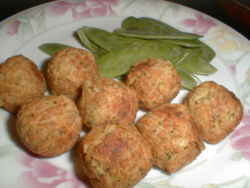 Plate of falafels and green vegetables
 -
 Pita with falafels and raw vegetables
 -
 Hummus from the Nile, with oil and lemon.


Socca and panisse[change | change source]
Socca is a specialty of Nice and Menton: it is a large, thin pancake made from chickpea flour, baked in the oven, and then sold by the slice on the street. It is found in Toulon under the name cade and in Liguria (Italy), where it is called farinata.
Panisse is another Provençal and Ligurian specialty: this time, the large, thicker galette is first cut into small cubes, which are then fried or baked in the oven. Panisses, too, are eaten “on the go,” that is, on the street.
-
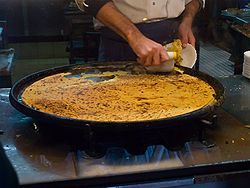 Socca, in Nice.
 -
 Farinata, in Liguria.
 -
 Panisse with spring onions (small onions), in Liguria.


See also[change | change source]
|
|
|


